
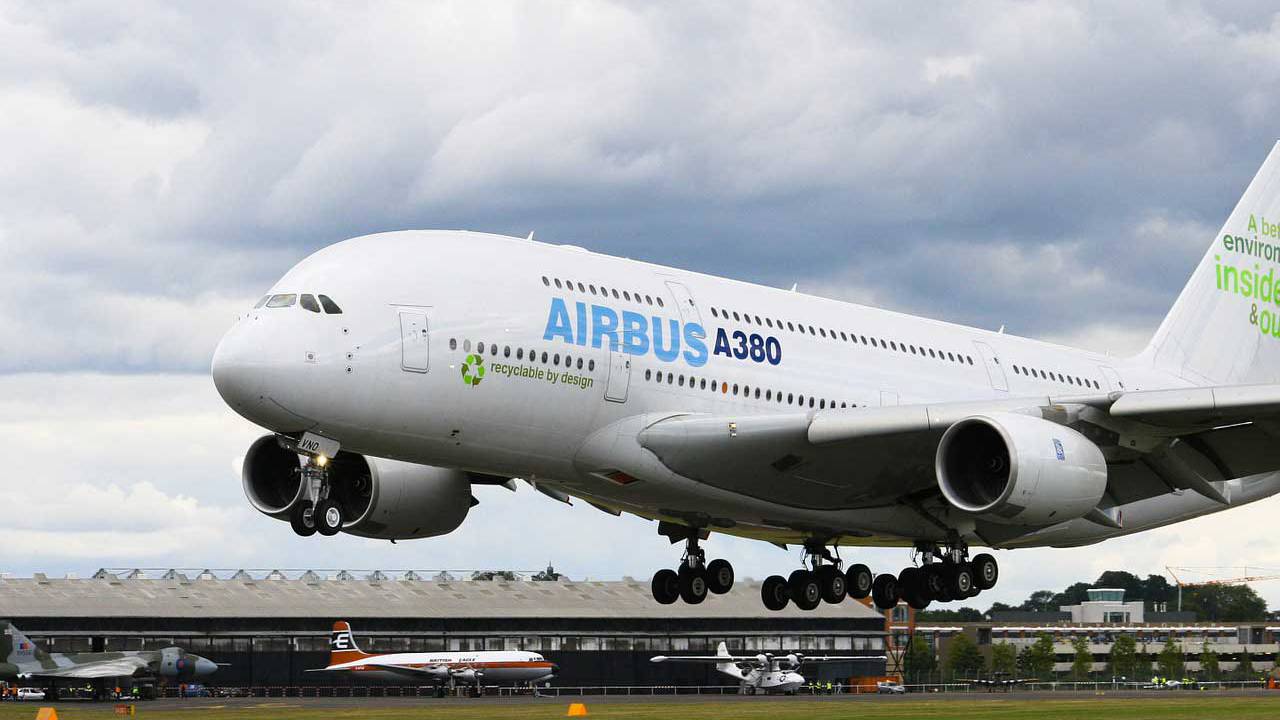
The largest passenger airliner ever put into commercial service, the A380, stands as one of the boldest engineering projects in aviation history. This enormous double-deck aircraft, powered by four massive engines and stretching out with a wingspan of about 262 feet, offered something truly unprecedented in capacity and internal volume. Airbus famously pointed out that if you included the cargo bay along with the main and upper decks, the aircraft could theoretically contain tens of millions of ping-pong balls—a playful way of illustrating just how vast its interior really was. Capable of holding well over 500 passengers in typical configurations, the aircraft’s sheer size helped it become a symbol of long-haul travel and global connectivity.
The A380 first took to the skies in 2005, a moment that left engineers, passengers, and aviation enthusiasts stunned by the sight of a machine this large lifting so gracefully from the runway. Yet on Valentine’s Day in 2019, Airbus confirmed that production would come to an end. The final aircraft would roll off the assembly line in 2021, closing the chapter on a program that captured worldwide attention.
The primary reason behind the decision was a reduction in expected orders, most notably from Emirates, the airline that became synonymous with the A380 experience. Though Emirates remains the largest operator of the fleet and will still take delivery of additional aircraft through 2021, its shifting strategy was enough to tip the balance for Airbus.
Aviation researchers reflected on the moment with a mix of admiration and inevitability. Richard Anderson, director of the Eagle Flight Research Center at Embry-Riddle Aeronautical University, noted that watching an aircraft of such size take off was a marvel—an example of what humans can achieve when engineering ambition reaches its peak. Yet compared to classic long-running programs, its service life was relatively brief. The iconic 747, for instance, first flew in 1969 and continues to have orders on Boeing’s books decades later. In contrast, the A380’s commercial debut in 2007 makes its production span strikingly short.

Evolving Priorities and the Shift Toward New Aircraft Sizes
Industry specialists have long analyzed how aircraft size influences profitability, efficiency, and flexibility. William Crossley, professor of aeronautics and astronautics at Purdue University, explains that both manufacturers and airlines are gradually discovering what could be considered the “right size” for modern commercial aviation. He suggests that the upper boundary of that ideal range aligns more with aircraft similar to the A350, which occupies a smaller, more manageable size category compared to the towering A380.
Airbus reports that orders for the A350 exceed a thousand, while total A380 orders stand at just 273. The contrast is striking not only in number but in momentum. The A350 entered commercial service much later, yet its market adoption quickly overtook that of the A380, reflecting industry demand for aircraft that balance capacity with operational flexibility.
An A350 typically accommodates between 325 and 366 passengers, depending on configuration. Other twin-engine wide-body aircraft occupy similar territory. The Boeing 777 line seats roughly 317 to 396 passengers, while Boeing’s 787 Dreamliner carries around 242 to 330 travelers. All these jets are sizeable and capable, yet they fall noticeably below the A380’s towering passenger count.
Manufacturers continue innovating within these ranges. Boeing, for example, is developing an advanced iteration of the 777 that features elegantly extended, fuel-efficient wings so long that they will need to fold at the tips to fit airport gates. These new designs highlight that efficiency and flexibility increasingly drive decision-making, even in the wide-body market.
Despite decades of aviation history suggesting that more seats should lead to higher profitability, the picture becomes more complicated when demand fluctuates. As Crossley notes, although spreading costs across 500 passengers might seem ideal, the equation collapses if a flight departs with too many empty seats. Airline economics depend as much on consistency as on potential capacity, and large aircraft become burdensome when the numbers don’t align.

The Practical Challenges Behind Operating the A380
The need for flexibility is a point emphasized by Anderson as well. He illustrates the advantage of using two long-range aircraft such as the 787 instead of a single enormous plane like the A380 on certain routes. If demand for a particular flight drops, an airline can simply remove one aircraft from the schedule. This option doesn’t exist when operating a massive jet; you can’t remove “half” of an A380. Its size demands consistently high passenger loads, and failing to achieve that makes operations significantly less efficient.
Engine configuration is another factor shaping the A380’s fate. With four engines instead of two, the aircraft naturally requires more fuel and more extensive maintenance. Modern engineering trends have made it possible for twin-engine jets to generate immense thrust safely and reliably. These engines are powerful enough that, even if one fails, the aircraft can typically continue to an airport without compromising safety. This reliability reduces the need for older four-engine designs, which once provided redundancy that is no longer as necessary with today’s technology.
Crossley explains that maintenance considerations add to this difference. Overhauling two engines takes less time and resources than maintaining four, which means airlines benefit from faster turnaround times and lower operating costs by choosing aircraft with fewer engines.
As Airbus shifts focus, the A380 still retains a strong presence among certain fleets. The aircraft will continue flying for years, supported by Airbus through maintenance, parts, and technical assistance. Emirates has placed orders for additional Airbus aircraft such as the A350 and A330 families—jets that reflect a future where efficiency and adaptability take precedence over sheer size.
Tom Enders, CEO of Airbus at the time, acknowledged the emotional weight of the announcement. He emphasized that passengers around the world genuinely loved the A380 experience and that its retirement from production would be deeply felt across aviation communities. Yet he also reminded the world that the aircraft’s story isn’t over. The skies will continue to see A380s for many years, carrying travelers aboard a machine that represented one of the boldest chapters in modern flight.