
Modern air power rests heavily on a handful of aircraft that can reach distant targets, survive sophisticated defenses and deliver devastating firepower with precision. Bombers sit at the heart of this capability, acting as long-range tools for deterrence, rapid response and strategic dominance. While fighter jets often receive more attention for their speed and maneuverability, bombers carry the burden of delivering massive payloads over continents, shaping military plans and influencing global stability in ways few other machines can.
The United States operates three of the most technologically advanced and combat-proven bombers ever built. Each one reflects a different era of engineering, defense strategy and technological evolution, yet all remain essential in today’s complex security environment. Some were designed during the height of the Cold War, others emerged from an effort to survive modern radar networks, and one blends speed with variable geometry to adapt to many mission profiles. Together, they represent decades of innovation in stealth, avionics, weapons integration and long-range endurance.
This article looks closely at the Boeing B-52 Stratofortress, the Northrop B-2 Spirit and the Rockwell B-1 Lancer. These aircraft are not simply large warplanes; they are high-tech platforms built to carry enormous payloads, navigate sophisticated defenses and execute operations that demand accuracy and reliability. Each bomber has a unique story, a set of strengths and a range of missions that highlight why the United States continues to invest in them. The deeper you dive into their engineering and design, the clearer it becomes why these three remain among the deadliest and most capable bombers ever flown.
USA Top 3 Most Deadliest Bomber
1. Boeing B-52 Stratofortress
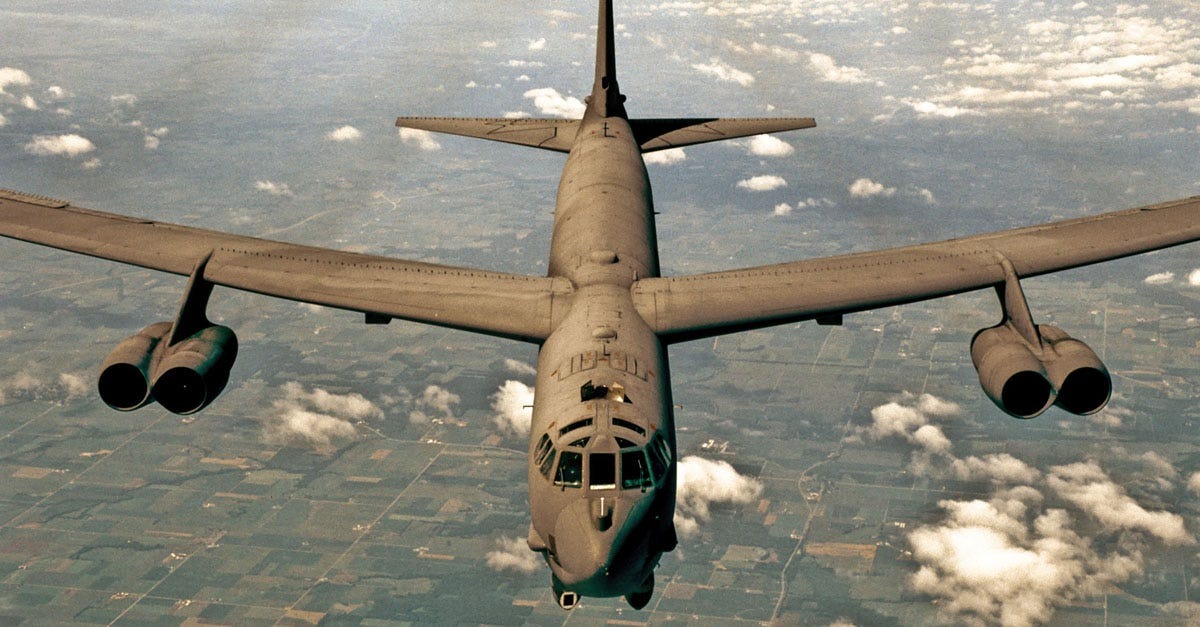
The Boeing B-52 Stratofortress is a long-range, subsonic heavy bomber that has become one of the most recognizable military aircraft in the world. Designed in the early stages of the Cold War, it was built to deliver nuclear weapons across intercontinental distances. Over time, its mission expanded to conventional warfare, precision strikes and support roles that demand enormous payloads and exceptional endurance. Operated by the United States Air Force since the 1950s, the B-52 has remained in service for decades because of its adaptability and the tremendous space it offers for upgrades.
With the ability to carry up to 70,000 pounds of weapons, the B-52 remains unmatched in sheer payload capacity among U.S. bombers. It can haul a mixture of air-to-surface missiles, bombs, mines and electronic countermeasure systems, making it suitable for missions ranging from strategic deterrence to close support in modern conflicts. Its typical combat range of more than 8,800 miles without aerial refueling allows it to reach distant targets while remaining airborne for long periods, a key advantage when missions require flexibility and global reach.
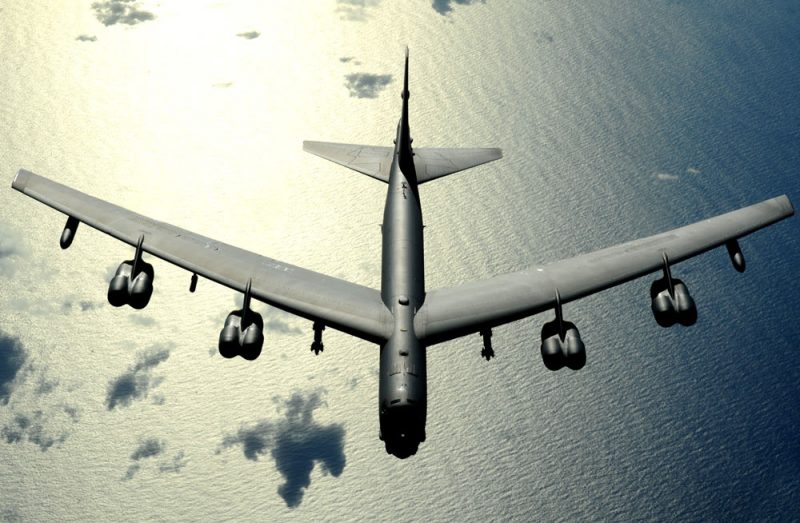
The bomber’s eight engines are arranged in pairs inside four pods mounted beneath the wings. This configuration not only provides redundancy and smooth power distribution but also acts as a form of aerodynamic control, helping delay wing stall and stabilize airflow. Early prototypes, the XB-52 and YB-52, used experimental Pratt & Whitney YJ57-P-3 turbojets, each producing 8,700 pounds of thrust. As technology improved, newer engines and avionics were introduced, extending the aircraft’s lifespan and improving its performance.
The B-52 made its first flight in April 1952 and eventually replaced the massive Convair B-36 in strategic roles. Although originally built as a nuclear delivery platform, the aircraft has only dropped conventional weapons in combat operations. Its official name, Stratofortress, is seldom used by its crews; instead, the aircraft is widely referred to by its long-standing nickname, BUFF, a reflection of its bulky appearance and rugged personality. Despite its age, ongoing modernization ensures that the B-52 remains relevant in a world where long-range strike capability is more important than ever.
2. The Northrop B-2 Spirit
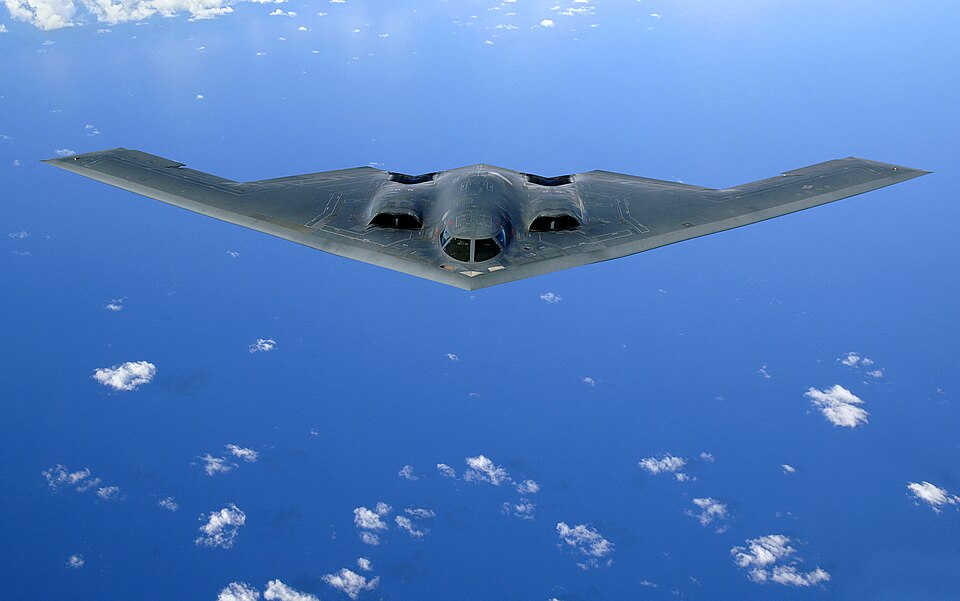
The Northrop (later Northrop Grumman) B-2 Spirit is one of the most advanced bombers ever developed, widely known for its stealth technology and distinctive flying-wing design. Created to penetrate the most heavily defended airspace in the world, the B-2 was engineered to remain undetected by radar systems, allowing it to reach targets while avoiding early warning networks. Its smooth, curved body and absence of vertical stabilizers are part of a careful design meant to scatter radar signals rather than reflect them.
The bomber carries both conventional and thermonuclear weapons, giving it a versatile and strategic role. It can deploy eighty 500-pound JDAM GPS-guided bombs for precision missions or carry B83 nuclear bombs when assigned to deterrence operations. The B-2 is also the only confirmed aircraft capable of carrying large air-to-surface standoff weapons while preserving its stealth profile, which allows it to destroy protected targets from significant distances without revealing its position.
To maximize its effectiveness, the aircraft integrates sophisticated avionics and sensor systems. Its low-probability-of-intercept AN/APQ-181 multi-mode radar allows terrain following and precise navigation even in heavy weather or blocked visibility. The digital navigation suite includes terrain-tracking radar and GPS guidance, blending multiple data sources into a reliable system for long-range missions. The NAS-26 astro-inertial navigation system, originally tested in the Northrop SM-62 Snark cruise missile, adds an additional layer of precision by referencing celestial objects.
Central to its survivability is the Defensive Management System, which alerts the crew to radar threats and analyzes the detection capabilities of enemy defenses. This system can evaluate multiple threats at once and suggest safer routes or flight changes, reducing exposure to hostile detection. Planned upgrades allow the aircraft to detect radar emissions and adjust its course in real time, enhancing its adaptability during complex operations.
The B-2 Spirit represents the blending of stealth, range and precision into a single platform. Its ability to strike anywhere in the world with minimal detection makes it a cornerstone of U.S. strategic capabilities, especially when missions require secrecy, accuracy and survivability.
3. The Rockwell B-1 Lancer
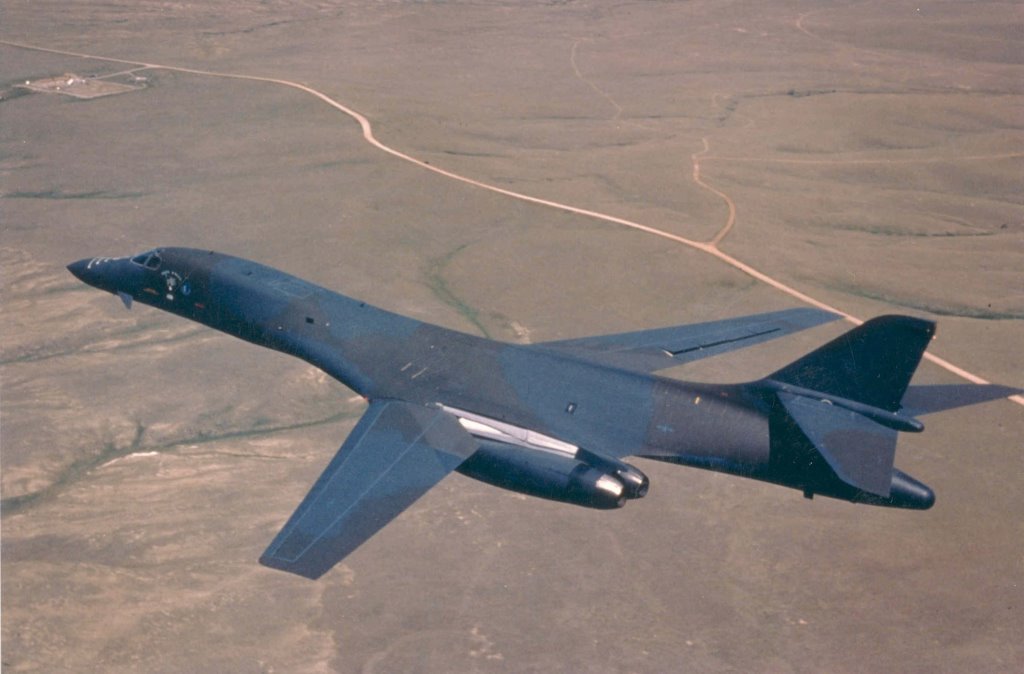
The Rockwell B-1 Lancer is a supersonic heavy bomber with variable-sweep wings that allow it to adapt its aerodynamics depending on speed and mission requirements. Nicknamed the Bone, the B-1 is one of the three main strategic bombers in the U.S. Air Force, alongside the B-2 Spirit and the B-52 Stratofortress. Its design balances high-speed penetration with long-range strike capability, making it suitable for both rapid attacks and extended operations over hostile territory.
Initial planning for the aircraft began in the 1960s, as engineers searched for a bomber that could combine the speed of the B-58 Hustler with the payload and range of the B-52. Rockwell International won the development contract for the B-1A, which featured a top speed above Mach 2 at high altitude and efficient low-level performance at Mach 0.85. These capabilities made it one of the fastest bombers ever tested, but shifting military priorities and the rising cost of development caused delays and adjustments in the program.
Another factor influencing the B-1’s development was the introduction of advanced cruise missiles. Systems like the AGM-86 could fly similar attack profiles at lower cost, shifting the strategic value equation. Early research into stealth technology also changed long-term planning. Nonetheless, the B-1 continued to evolve, eventually entering service as the B-1B, optimized for low-altitude penetration and reduced radar signatures.
One of the aircraft’s most notable features is its onboard computing system. The IBM AP-101 computer, also used on the Space Shuttle and later models of the B-52, provides essential mission processing and avionics support. Programmed in the JOVIAL language, it manages communications, navigation and weapons systems with robust reliability.
The B-1 carries a sophisticated suite of offensive avionics, including the AN/APQ-164 passive electronically scanned array radar. This system supports terrain following, synthetic aperture imaging and ground moving target indication, giving the aircraft accurate guidance even at high speeds or low altitudes. Additional tools such as Doppler navigation, radar altimetry and inertial navigation enhance its ability to operate independently in difficult environments.
Through its combination of speed, adaptability and advanced avionics, the B-1 Lancer remains a powerful component of U.S. strategic aviation. It can carry large payloads, cover immense distances and approach targets using tactics that blend stealth, precision and high-speed maneuvering, ensuring its continued relevance in modern operations.