
Trump, Rubio, and the UFO Transparency Debate: What’s Really Going On?

For most of modern history, UFOs lived on the edge of public conversation. They appeared briefly during moments of panic or curiosity, then quietly faded back into jokes, rumors, or science fiction. What’s happening now feels different. The subject hasn’t just returned — it’s settled into politics, defense briefings, and mainstream media in a way it never quite managed before.

When a sitting U.S. president is urged to clarify what he knows, and senior senators openly push intelligence agencies for transparency, the issue stops being entertainment. It becomes a question of governance, trust, and control of information. The recent discussion highlighted in the Backscroll video isn’t about proving aliens exist. It’s about why the subject refuses to disappear, why official language keeps changing, and why governments seem permanently caught between disclosure and silence.

Behind the headlines lies a deeper tension. On one side is a public that has grown skeptical of secrecy and impatient with vague answers. On the other is a system built on classification, strategic ambiguity, and the belief that not everything should be shared, even if it exists. UFOs — now carefully labeled as UAPs — sit exactly at that fault line.

This article looks beyond the usual extremes. Not blind belief, not automatic dismissal. Instead, it examines what politicians are actually arguing about, what governments have admitted so far, why full transparency is so rare, and what real-world incentives exist to keep certain answers out of public reach — whether those answers involve advanced technology, misunderstood phenomena, or something still unresolved.

What matters here isn’t whether UFOs are aliens. It’s why the question itself has become impossible to ignore.


The New UFO Language Game: Why “UAP” Changed Everything

A big reason today’s conversation feels different is the vocabulary. “UFO” is emotionally loaded. “UAP” sounds bureaucratic and technical, which is the point. Governments don’t just rename topics for fun; they rename them to reframe them.

UAP—Unidentified Anomalous Phenomena—moves the question away from “spaceships” and closer to “things our sensors picked up that require analysis.” It’s a way to pull the subject into national security, aviation safety, and intelligence oversight—without promising anything exotic.


What the Video Moment Really Represents: A Political Turning Point

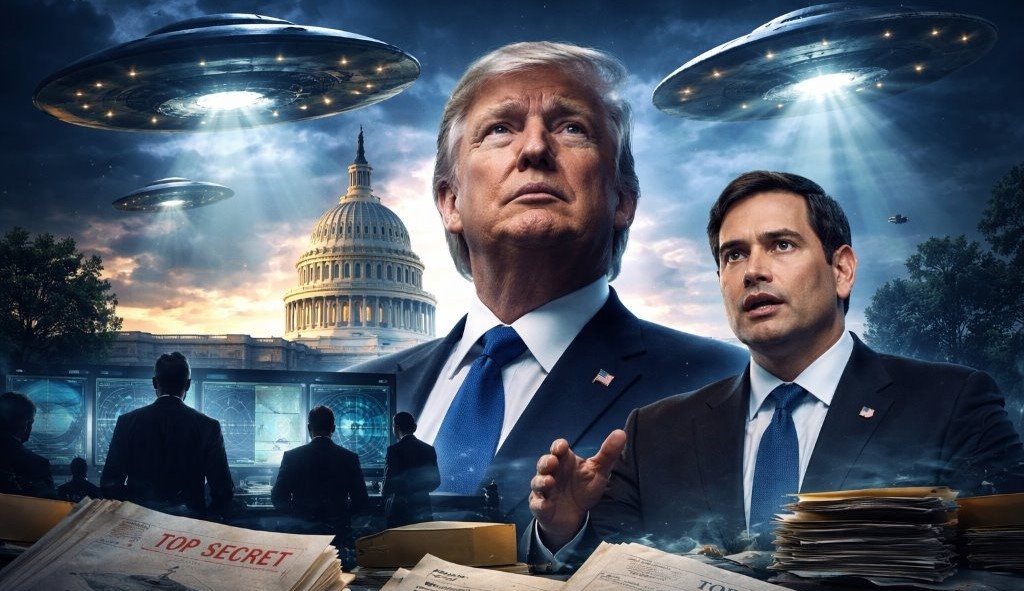
The Backscroll framing—Trump being urged to clarify UFO information while Rubio pushes transparency—points at a real political pressure cycle: when lawmakers publicly demand answers, it forces agencies to either share information or justify why they can’t.

Rubio, in particular, has been linked repeatedly to the idea that government insiders have provided claims that can’t just be brushed off as “internet rumors,” even if those claims still aren’t proven publicly.

And once a topic becomes part of the political bloodstream—cable news segments, committee questions, official reports—it stops being only about curiosity. It becomes about legitimacy, trust, and who gets to control the narrative.


Congress and the “Show Us the Receipts” Era

One reason UFO talk keeps resurfacing is that Congress has been turning it into a formal oversight issue. There have been hearings and official transcripts framed around national security, public safety, and transparency—words that make it harder to dismiss the subject as entertainment.

This shift matters because oversight works like a slow grind. It’s not one dramatic reveal. It’s requests, briefings, reporting requirements, follow-up questions, and arguments about what should be classified and what shouldn’t.


What the Pentagon Has Publicly Said: No Verified Alien Evidence

Here’s the most grounded piece of the puzzle: the U.S. Department of Defense’s UAP office (AARO) has repeatedly stated that it has found no verifiable evidence that UAP reports represent extraterrestrial beings, activity, or technology. That includes a historical review of U.S. government investigations going back decades.

That doesn’t mean every case is “explained.” It means the office says the evidence it has reviewed does not support the claim of confirmed alien technology. Reuters’ coverage of the Pentagon’s historical report reflects the same conclusion: most sightings are attributed to misidentified ordinary objects or natural phenomena, with no evidence of extraterrestrial tech. 

So if someone tells you “the Pentagon admitted aliens,” that’s not what the official reporting says.


So What Are People Actually Seeing? The Realistic Explanations That Cover Most Cases

Most UAP reports land in the unglamorous bucket: balloons, birds, drones, aircraft, satellites, atmospheric effects, and sensor confusion. The Associated Press summary of a more recent AARO report describes hundreds of cases, with many resolved as balloons, drones, birds, and satellites (including Starlink), while others stay unresolved because there isn’t enough data. 

AARO even posts official UAP imagery and case outcomes, including examples resolved as balloons or birds, and some labeled unresolved due to insufficient information.

If you run websites, you’ll appreciate this comparison: most “mystery” problems aren’t mysterious—they’re missing logs, missing context, or a misread metric. UFOs often work the same way. When the data is partial, the human brain fills in the gap with drama.


The Hard Cases: Why Some Reports Stay Unresolved Without Proving Anything Exotic

Unresolved doesn’t mean extraterrestrial. It usually means one of these:

  • the sighting was too brief

  • the sensor data isn’t complete

  • the object was too far away for reliable sizing

  • there’s no multi-sensor confirmation

  • classified context can’t be attached publicly

The AP reporting notes that a portion of cases remain unclosed because the data is insufficient for firm conclusions.

This is where both sides make mistakes:

  • believers sometimes treat “unresolved” as “confirmed aliens”

  • skeptics sometimes treat “unresolved” as “nothing happened”

In reality, “unresolved” is just a label for incomplete certainty.


Why Governments Might Hide the Truth If Aliens Were Real

Now we get to your core question: if something truly non-human existed, why would governments hide it?

There are a few reasons that get discussed seriously, even by people who don’t buy the alien hypothesis:

1) National security and capability protection

Even if the phenomenon is not alien, the data behind it often reveals how your sensors work—what they can detect, from how far, under what conditions. That kind of information is priceless to adversaries.

2) Avoiding public panic (and avoiding economic chaos)

It’s not just “people will panic” in a cartoon way. It’s the ripple effects: markets, travel, religion, social stability, conspiracy movements, distrust spikes, and a general feeling that the people in charge aren’t in charge anymore. Governments don’t like that feeling, and they especially don’t like it spreading.

3) Control of the narrative

If you can’t fully explain something, you still might want to control how it’s perceived. “We don’t know” can be interpreted as weakness. Governments tend to communicate certainty, even when reality is messy.

4) Legal and accountability landmines

If a government hid something for decades—alien-related or not—then disclosure isn’t just an announcement. It becomes a scandal: who funded it, who approved it, who lied, what laws were broken, what oversight failed.

AARO’s own public messaging includes the claim that it found no evidence of illegally or inappropriately withheld UAP information from Congress, which is basically a direct response to that accountability fear.


The Other Possibility: Governments Aren’t Hiding Aliens, They’re Hiding Human Stuff

Here’s the angle that quietly explains a lot of the secrecy without requiring extraterrestrials.

Historically, some UFO narratives have overlapped with secret military programs. Advanced aircraft testing, drone prototypes, electronic warfare experiments—these can look bizarre to witnesses and even to other parts of government that are out of the loop.

The Pentagon’s historical review, as covered by Reuters, explicitly discusses how misidentification and classified program confusion fueled myths over time, while still concluding there’s no evidence of extraterrestrial tech in what they reviewed.

So the “truth” that’s being protected might be disappointing to alien fans… but extremely valuable to militaries.


Culture and Media: Why UFO Stories Spread Faster Than UFO Facts

Even if 90% of sightings are mundane, the remaining 10% is enough to keep the story alive forever—because UFOs sit perfectly in the modern attention economy.

  • The topic triggers wonder and fear at the same time

  • Official silence feels like confirmation

  • A single dramatic clip outruns 50 boring clarifications

  • Communities form around belief, not around uncertainty

And once belief becomes identity, evidence becomes optional. That’s not even a UFO problem—it’s a human problem.


What Would Real Disclosure Look Like, If It Ever Happened?

If there were ever a genuine “this is not human” moment, it probably wouldn’t arrive through a low-resolution video clip.

It would look more like:

  • consistent multi-sensor tracking across multiple incidents

  • physical materials available for independent scientific study

  • transparent chains of custody and documentation

  • repeatable, testable results

  • testimony backed by verifiable records, not just claims

Right now, the official government posture is basically the opposite: lots of reports, many resolved as ordinary things, some unresolved due to insufficient data, and no verified evidence of extraterrestrial technology or beings.

That doesn’t close the book. But it explains why the argument keeps looping.


Where Trump and Rubio Fit Into the Bigger Story

The reason politicians become magnets in this debate is simple: they represent a potential shortcut. People assume a president or a high-level senator could “just say it.”

In reality, even top politicians deal with:

  • classification barriers

  • compartmentalized programs

  • intelligence tradeoffs

  • institutional incentives to say less, not more

So when the public urges someone like Trump to clarify UFO information, it’s not only about curiosity. It’s about forcing the system to either confirm, deny, or at least explain the boundaries of what can be said.


Where This Leaves Us

At this point, the UFO debate isn’t really about flying objects anymore. It’s about information—who controls it, how it’s filtered, and when uncertainty becomes a political problem rather than a scientific one. That’s why figures like senators, intelligence officials, and former presidents keep getting pulled into the discussion. Not because they’re expected to confirm aliens, but because they sit closest to the boundaries of what can and cannot be said.

Most sightings will continue to have ordinary explanations. Some will remain unresolved due to incomplete data. And a very small fraction will continue to resist easy classification, not because they prove something extraordinary, but because modern surveillance systems are far better at detecting anomalies than at explaining them in real time. That gap between detection and understanding is where tension grows.

If governments ever do possess information that goes beyond current public knowledge, silence wouldn’t necessarily be proof of deception—it would be a predictable response to uncertainty, strategic risk, and fear of losing narrative control. Institutions are built to manage stability, not curiosity. Disclosure only happens when the cost of secrecy becomes higher than the cost of speaking.

For now, the UFO question remains open, not because the truth is necessarily shocking, but because it’s incomplete. And in a world where technology moves faster than interpretation, unanswered questions don’t fade away—they accumulate. Whether the future brings clearer explanations or deeper complications, the conversation itself is no longer fringe. It has moved into the center of how modern societies negotiate trust, power, and the limits of what they claim to know.

Trump, Rubio, and the UFO Transparency Debate: What’s Really Going On?

Trump, Rubio, and the UFO Transparency Debate: What’s Really Going On?

For most of modern history, UFOs lived on the edge of public conversation. They appeared briefly during moments of panic or curiosity, then quietly faded back into jokes, rumors, or science fiction. What’s happening now feels different. The subject hasn’t just returned — it’s settled into politics, defense briefings, and mainstream media in a way it never quite managed before.

When a sitting U.S. president is urged to clarify what he knows, and senior senators openly push intelligence agencies for transparency, the issue stops being entertainment. It becomes a question of governance, trust, and control of information. The recent discussion highlighted in the Backscroll video isn’t about proving aliens exist. It’s about why the subject refuses to disappear, why official language keeps changing, and why governments seem permanently caught between disclosure and silence.

Behind the headlines lies a deeper tension. On one side is a public that has grown skeptical of secrecy and impatient with vague answers. On the other is a system built on classification, strategic ambiguity, and the belief that not everything should be shared, even if it exists. UFOs — now carefully labeled as UAPs — sit exactly at that fault line.

This article looks beyond the usual extremes. Not blind belief, not automatic dismissal. Instead, it examines what politicians are actually arguing about, what governments have admitted so far, why full transparency is so rare, and what real-world incentives exist to keep certain answers out of public reach — whether those answers involve advanced technology, misunderstood phenomena, or something still unresolved.

What matters here isn’t whether UFOs are aliens. It’s why the question itself has become impossible to ignore.


The New UFO Language Game: Why “UAP” Changed Everything

A big reason today’s conversation feels different is the vocabulary. “UFO” is emotionally loaded. “UAP” sounds bureaucratic and technical, which is the point. Governments don’t just rename topics for fun; they rename them to reframe them.

UAP—Unidentified Anomalous Phenomena—moves the question away from “spaceships” and closer to “things our sensors picked up that require analysis.” It’s a way to pull the subject into national security, aviation safety, and intelligence oversight—without promising anything exotic.


What the Video Moment Really Represents: A Political Turning Point

The Backscroll framing—Trump being urged to clarify UFO information while Rubio pushes transparency—points at a real political pressure cycle: when lawmakers publicly demand answers, it forces agencies to either share information or justify why they can’t.

Rubio, in particular, has been linked repeatedly to the idea that government insiders have provided claims that can’t just be brushed off as “internet rumors,” even if those claims still aren’t proven publicly.

And once a topic becomes part of the political bloodstream—cable news segments, committee questions, official reports—it stops being only about curiosity. It becomes about legitimacy, trust, and who gets to control the narrative.


Congress and the “Show Us the Receipts” Era

One reason UFO talk keeps resurfacing is that Congress has been turning it into a formal oversight issue. There have been hearings and official transcripts framed around national security, public safety, and transparency—words that make it harder to dismiss the subject as entertainment.

This shift matters because oversight works like a slow grind. It’s not one dramatic reveal. It’s requests, briefings, reporting requirements, follow-up questions, and arguments about what should be classified and what shouldn’t.


What the Pentagon Has Publicly Said: No Verified Alien Evidence

Here’s the most grounded piece of the puzzle: the U.S. Department of Defense’s UAP office (AARO) has repeatedly stated that it has found no verifiable evidence that UAP reports represent extraterrestrial beings, activity, or technology. That includes a historical review of U.S. government investigations going back decades.

That doesn’t mean every case is “explained.” It means the office says the evidence it has reviewed does not support the claim of confirmed alien technology. Reuters’ coverage of the Pentagon’s historical report reflects the same conclusion: most sightings are attributed to misidentified ordinary objects or natural phenomena, with no evidence of extraterrestrial tech. 

So if someone tells you “the Pentagon admitted aliens,” that’s not what the official reporting says.


So What Are People Actually Seeing? The Realistic Explanations That Cover Most Cases

Most UAP reports land in the unglamorous bucket: balloons, birds, drones, aircraft, satellites, atmospheric effects, and sensor confusion. The Associated Press summary of a more recent AARO report describes hundreds of cases, with many resolved as balloons, drones, birds, and satellites (including Starlink), while others stay unresolved because there isn’t enough data. 

AARO even posts official UAP imagery and case outcomes, including examples resolved as balloons or birds, and some labeled unresolved due to insufficient information.

If you run websites, you’ll appreciate this comparison: most “mystery” problems aren’t mysterious—they’re missing logs, missing context, or a misread metric. UFOs often work the same way. When the data is partial, the human brain fills in the gap with drama.


The Hard Cases: Why Some Reports Stay Unresolved Without Proving Anything Exotic

Unresolved doesn’t mean extraterrestrial. It usually means one of these:

  • the sighting was too brief

  • the sensor data isn’t complete

  • the object was too far away for reliable sizing

  • there’s no multi-sensor confirmation

  • classified context can’t be attached publicly

The AP reporting notes that a portion of cases remain unclosed because the data is insufficient for firm conclusions.

This is where both sides make mistakes:

  • believers sometimes treat “unresolved” as “confirmed aliens”

  • skeptics sometimes treat “unresolved” as “nothing happened”

In reality, “unresolved” is just a label for incomplete certainty.


Why Governments Might Hide the Truth If Aliens Were Real

Now we get to your core question: if something truly non-human existed, why would governments hide it?

There are a few reasons that get discussed seriously, even by people who don’t buy the alien hypothesis:

1) National security and capability protection

Even if the phenomenon is not alien, the data behind it often reveals how your sensors work—what they can detect, from how far, under what conditions. That kind of information is priceless to adversaries.

2) Avoiding public panic (and avoiding economic chaos)

It’s not just “people will panic” in a cartoon way. It’s the ripple effects: markets, travel, religion, social stability, conspiracy movements, distrust spikes, and a general feeling that the people in charge aren’t in charge anymore. Governments don’t like that feeling, and they especially don’t like it spreading.

3) Control of the narrative

If you can’t fully explain something, you still might want to control how it’s perceived. “We don’t know” can be interpreted as weakness. Governments tend to communicate certainty, even when reality is messy.

4) Legal and accountability landmines

If a government hid something for decades—alien-related or not—then disclosure isn’t just an announcement. It becomes a scandal: who funded it, who approved it, who lied, what laws were broken, what oversight failed.

AARO’s own public messaging includes the claim that it found no evidence of illegally or inappropriately withheld UAP information from Congress, which is basically a direct response to that accountability fear.


The Other Possibility: Governments Aren’t Hiding Aliens, They’re Hiding Human Stuff

Here’s the angle that quietly explains a lot of the secrecy without requiring extraterrestrials.

Historically, some UFO narratives have overlapped with secret military programs. Advanced aircraft testing, drone prototypes, electronic warfare experiments—these can look bizarre to witnesses and even to other parts of government that are out of the loop.

The Pentagon’s historical review, as covered by Reuters, explicitly discusses how misidentification and classified program confusion fueled myths over time, while still concluding there’s no evidence of extraterrestrial tech in what they reviewed.

So the “truth” that’s being protected might be disappointing to alien fans… but extremely valuable to militaries.


Culture and Media: Why UFO Stories Spread Faster Than UFO Facts

Even if 90% of sightings are mundane, the remaining 10% is enough to keep the story alive forever—because UFOs sit perfectly in the modern attention economy.

  • The topic triggers wonder and fear at the same time

  • Official silence feels like confirmation

  • A single dramatic clip outruns 50 boring clarifications

  • Communities form around belief, not around uncertainty

And once belief becomes identity, evidence becomes optional. That’s not even a UFO problem—it’s a human problem.


What Would Real Disclosure Look Like, If It Ever Happened?

If there were ever a genuine “this is not human” moment, it probably wouldn’t arrive through a low-resolution video clip.

It would look more like:

  • consistent multi-sensor tracking across multiple incidents

  • physical materials available for independent scientific study

  • transparent chains of custody and documentation

  • repeatable, testable results

  • testimony backed by verifiable records, not just claims

Right now, the official government posture is basically the opposite: lots of reports, many resolved as ordinary things, some unresolved due to insufficient data, and no verified evidence of extraterrestrial technology or beings.

That doesn’t close the book. But it explains why the argument keeps looping.


Where Trump and Rubio Fit Into the Bigger Story

The reason politicians become magnets in this debate is simple: they represent a potential shortcut. People assume a president or a high-level senator could “just say it.”

In reality, even top politicians deal with:

  • classification barriers

  • compartmentalized programs

  • intelligence tradeoffs

  • institutional incentives to say less, not more

So when the public urges someone like Trump to clarify UFO information, it’s not only about curiosity. It’s about forcing the system to either confirm, deny, or at least explain the boundaries of what can be said.


Where This Leaves Us

At this point, the UFO debate isn’t really about flying objects anymore. It’s about information—who controls it, how it’s filtered, and when uncertainty becomes a political problem rather than a scientific one. That’s why figures like senators, intelligence officials, and former presidents keep getting pulled into the discussion. Not because they’re expected to confirm aliens, but because they sit closest to the boundaries of what can and cannot be said.

Most sightings will continue to have ordinary explanations. Some will remain unresolved due to incomplete data. And a very small fraction will continue to resist easy classification, not because they prove something extraordinary, but because modern surveillance systems are far better at detecting anomalies than at explaining them in real time. That gap between detection and understanding is where tension grows.

If governments ever do possess information that goes beyond current public knowledge, silence wouldn’t necessarily be proof of deception—it would be a predictable response to uncertainty, strategic risk, and fear of losing narrative control. Institutions are built to manage stability, not curiosity. Disclosure only happens when the cost of secrecy becomes higher than the cost of speaking.

For now, the UFO question remains open, not because the truth is necessarily shocking, but because it’s incomplete. And in a world where technology moves faster than interpretation, unanswered questions don’t fade away—they accumulate. Whether the future brings clearer explanations or deeper complications, the conversation itself is no longer fringe. It has moved into the center of how modern societies negotiate trust, power, and the limits of what they claim to know.