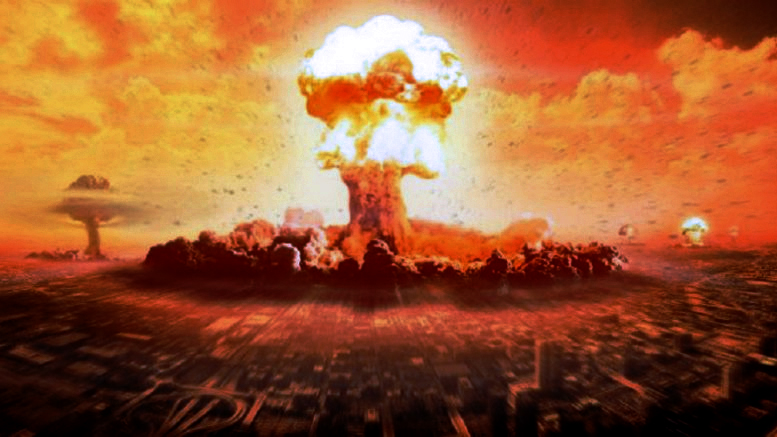
The story of the world’s most powerful nuclear weapons is inseparable from the fears, ambitions, and rivalries of the twentieth century. These devices were not created in a vacuum, nor were they designed purely for military practicality. They emerged from an era defined by existential anxiety, when global powers believed that survival depended on possessing weapons so devastating that no enemy would dare strike first. In that environment, explosive yield became a kind of currency, a measurable symbol of national strength, technological superiority, and political resolve.
From the early days of atomic experimentation to the height of the Cold War, nuclear design followed a relentless logic: bigger meant safer, stronger meant more secure. Each breakthrough by one side pushed the other to respond with something even more powerful. Scientists were asked not simply to build weapons, but to stretch the limits of physics itself, converting mass into energy on scales never before achieved. Governments justified these efforts as deterrence, yet the weapons that resulted often exceeded any realistic military use, existing instead as instruments of intimidation and strategic signaling.
What makes these weapons particularly striking is not only their raw explosive power, but the mindset that produced them. Many of the bombs on this list were so large, heavy, and complex that deploying them in actual combat would have been extraordinarily difficult. Some were never meant to be used at all. They were proofs of concept, political statements, or responses to intelligence estimates that assumed the worst about an adversary’s capabilities. In several cases, yields were deliberately reduced, not because the technology could not go further, but because even their creators recognized the catastrophic consequences of unleashing their full potential.
Ranking the biggest and most powerful nuclear weapons is therefore not just an exercise in numbers. It is a way of tracing how far nuclear escalation went, and how close humanity came to normalizing destruction on a planetary scale. The devices listed below represent peak moments in that escalation, when engineering brilliance and strategic fear collided. Each one reflects a specific historical context, a particular set of assumptions about war, security, and power, and together they form a stark reminder of an age when the ability to destroy entire cities—or far more—was treated as a necessary safeguard for peace.
Tsar Bomba (RDS-220 hydrogen bomb) – 50 megatons

The RDS-220, better known as the Tsar Bomba, remains the most powerful nuclear device ever detonated. Developed by the Soviet Union, it was tested on 30 October 1961 over Novaya Zemlya, a remote archipelago in the Arctic Ocean. Even by Cold War standards, the test was intended as a demonstration of overwhelming capability rather than a practical battlefield weapon.
The bomb was dropped from a specially modified Tu-95 bomber and deployed using an enormous parachute designed to slow its descent, giving the aircraft time to escape. The detonation occurred roughly four kilometers above the ground, producing a yield of approximately 50 megatons. This explosion is commonly described as equivalent to about 3,800 Hiroshima-scale bombs detonated simultaneously, a comparison that highlights its unprecedented scale.
Unlike most thermonuclear weapons, Tsar Bomba used a three-stage design. While the original theoretical yield was estimated at 100 megatons, engineers deliberately reduced it by half to limit radioactive fallout. Even so, the blast shattered windows hundreds of kilometers away, and the shockwave reportedly circled the Earth multiple times.
B41 (Mk-41) nuclear bomb – 25 megatons
The B41, also known as the Mk-41, was the most powerful thermonuclear weapon ever deployed by the United States. With a maximum yield of around 25 megatons, it represented the American response to the era of super-weapons. Approximately 500 units were produced between 1960 and 1962, and the bomb remained in service until the mid-1970s.
Development of the Mk-41 began in the mid-1950s to meet U.S. Air Force requirements for a very high-yield weapon capable of strategic bombing missions. Its design incorporated a three-stage thermonuclear configuration, boosted by deuterium-tritium reactions and fueled by highly enriched lithium-6 deuteride.
Two primary variants existed: a so-called “clean” version designed to reduce radioactive fallout, and a “dirty” version that used a uranium-encased stage to increase yield at the cost of greater contamination. Both versions were delivered by aircraft and relied on parachutes to delay detonation, allowing the bomber time to escape the blast radius.
TX-21 “Shrimp” (Castle Bravo device) – 14.8 megatons
The TX-21, nicknamed “Shrimp,” was the device used in the Castle Bravo test, the largest nuclear explosion ever conducted by the United States. Detonated on 1 March 1954 at Bikini Atoll in the Marshall Islands, the test yielded 14.8 megatons—far exceeding expectations and resulting in severe radioactive fallout.
Shrimp was a scaled-down derivative of earlier experimental designs and relied on lithium deuteride as fusion fuel. Engineers underestimated how much lithium-7 would contribute to the reaction, leading to a yield far higher than predicted. The explosion occurred just above the surface, spreading radioactive debris across more than 11,000 square kilometers.
Fallout from Castle Bravo contaminated nearby islands and reached distant regions, exposing populations and personnel to dangerous radiation levels. The test became a turning point in public awareness of nuclear fallout and its long-term consequences.
Mk-17 / EC-17 – 10 to 15 megatons

The Mk-17 was the heaviest thermonuclear weapon ever built by the United States and marked the first operational hydrogen bomb in U.S. Air Force service. With an estimated yield ranging between 10 and 15 megatons, it represented a transitional step between experimental devices and deployable strategic weapons.
Weighing more than 18 metric tons, the Mk-17 was enormous even by bomber standards. Around 200 units were produced by the mid-1950s before the weapon was retired just a few years later. Its sheer size made handling and deployment difficult, and advances in design quickly rendered it obsolete.
Delivery required a B-36 bomber and a massive parachute system to slow descent, allowing the aircraft additional time to escape. The weapon’s brief service life reflects how rapidly nuclear technology evolved during that period.
Mk-24 (B-24 / EC-24) – 10 to 15 megatons
The Mk-24 was another high-yield thermonuclear bomb developed by the United States, closely related in appearance and function to the Mk-17. Its design was based on the “Yankee” test device, one of the detonations in the Castle test series.
Produced in several configurations, the Mk-24 could achieve yields between 10 and 15 megatons. A total of 105 units were manufactured between 1954 and 1955 before the weapon was retired shortly thereafter. The deployed prototype, designated EC-24, was tested in May 1954 and produced a yield of approximately 13.5 megatons.
Although powerful, the Mk-24 suffered from the same limitations as other early thermonuclear bombs: massive size, logistical complexity, and rapid obsolescence as lighter, more efficient designs emerged.
Ivy Mike hydrogen bomb – 10.4 megatons
Ivy Mike was not a weapon in the traditional sense, but rather a massive experimental device used to prove the feasibility of thermonuclear fusion. Detonated in November 1952 as part of Operation Ivy, it yielded 10.4 megatons, roughly 700 times the explosive power of the Hiroshima bomb.
The device was enormous, measuring several meters in length and weighing more than 80 tons. It used liquid deuterium as fusion fuel and required extensive refrigeration systems, making it impossible to deploy as an actual weapon. Its purpose was purely experimental: to demonstrate that a fusion bomb could work.
The success of Ivy Mike paved the way for later, weaponized thermonuclear designs that replaced liquid fuel with solid lithium compounds.
Mk-36 nuclear bomb – 10 megatons
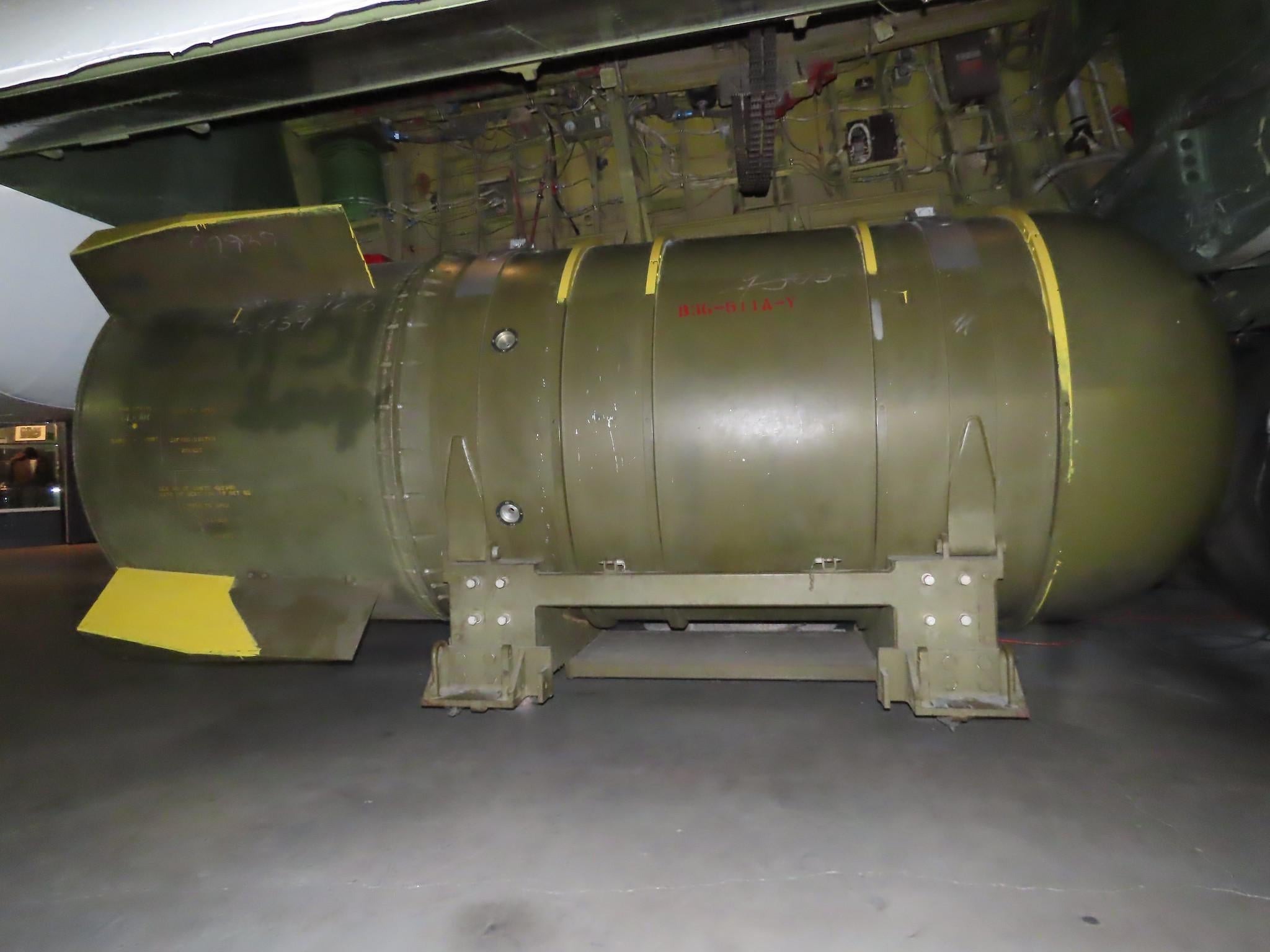
The Mk-36 was a two-stage thermonuclear bomb that incorporated multi-stage fusion to achieve yields of up to 10 megatons. Developed as an evolution of earlier designs, it came in two main variants and was produced in large numbers during the late 1950s.
Nearly 1,000 Mk-36 bombs were manufactured between 1956 and 1958, making it one of the most widely produced high-yield thermonuclear weapons. Many were later converted into other configurations as technology advanced.
Designed for air delivery, the Mk-36 relied on parachutes to manage descent and timing. By the early 1960s, it had been retired and replaced by newer designs offering similar power with greater efficiency.
B53 (Mk-53) – 9 megatons
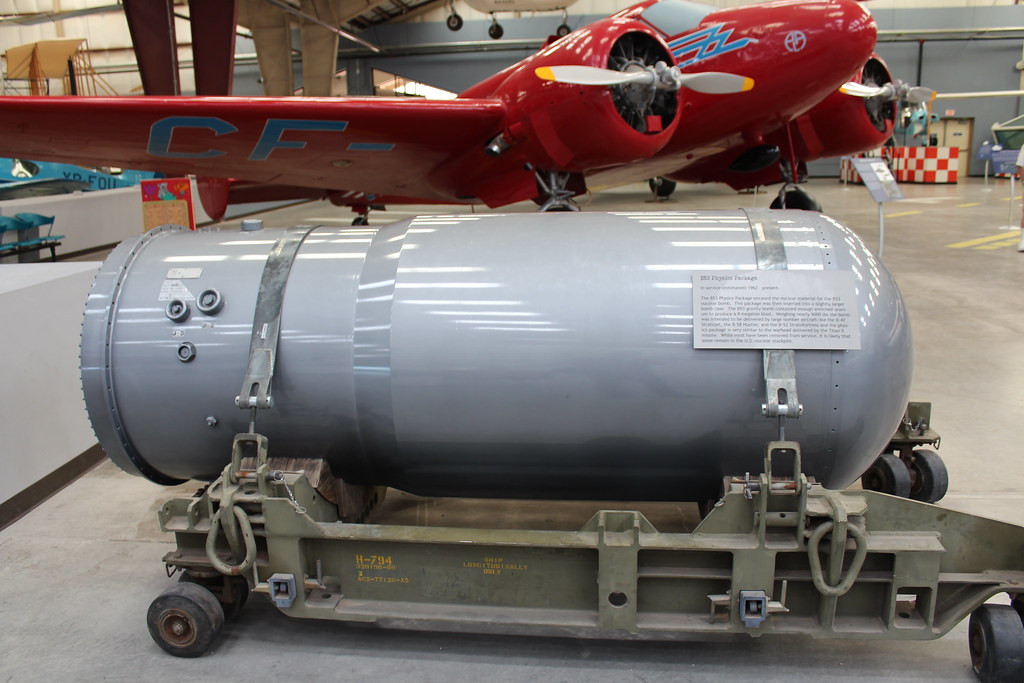
The B53 was one of the longest-serving high-yield nuclear weapons in the U.S. arsenal. With an estimated yield of 9 megatons, it remained in service until the late 1990s, long after many earlier bombs had been retired.
The weapon was designed as a two-stage thermonuclear bomb using highly enriched uranium and lithium-6 deuteride fusion fuel. It could be carried by several types of strategic bombers and was equipped with a complex parachute system to control delivery.
Despite its age, the B53 remained part of the U.S. stockpile for decades due to its reliability and sheer destructive capability, finally being dismantled as arms-reduction efforts progressed.
images/2imageB41.jpg
Mk-16 (TX-16 / EC-16) nuclear bomb – 7 megatons
The Mk-16 holds the distinction of being the only liquid-fuel thermonuclear weapon ever built by the United States. Based directly on the Ivy Mike concept, it had an estimated yield of up to 7 megatons.
Because it relied on cryogenic liquid fuel, the Mk-16 was impractical for long-term deployment. It was produced in limited Experimental and Emergency Capability versions and briefly entered service before being retired within months.
Its rapid replacement by solid-fuel thermonuclear weapons underscores how quickly early fusion technology evolved once its basic feasibility had been proven.
images/5imageIvyMike.jpg
Mk-14 (TX-14) – 6.9 megatons
The Mk-14 was the first solid-fuel thermonuclear weapon fielded by the United States, marking a major technological milestone. Tested during the Castle Union nuclear test in 1954, it produced a yield of 6.9 megatons.
Unlike earlier designs that depended on liquid fuel, the Mk-14 used lithium-6, allowing for a more compact and deployable weapon. Approved for production in the early 1950s, it entered service briefly before being retired and partially recycled into later weapons.
Carried by strategic bombers and delivered using parachute systems, the Mk-14 represented the transition from experimental fusion devices to practical thermonuclear arsenals capable of sustained deployment.

Together, these weapons illustrate the extreme trajectory nuclear development took during the mid-20th century, when yield and spectacle often outweighed practicality. While many of these devices were never intended for real-world use, their existence shaped global politics, military strategy, and the persistent awareness of just how destructive human technology can become.